The Landed Cost Workbook
Price one import per unit before you order: the weight you are billed on, the containers the order really needs, freight per unit by mode, two exchange rates, your destination's customs value, duty and import tax on the right base, and one landed cost per unit
PortEntry's calculators each answer one question, and the freight ones never reach the money ones. Container Load counts cartons by space only, so for dense cargo its container count is too low. Volumetric Weight gives a chargeable weight that never becomes a freight figure. Customs Value offers FOB, CFR and CIF as if the choice were yours, when your destination's law has already made it. Landed Cost asks you to type a freight figure and a duty no tool produced. The Landed Cost Workbook joins them up in seven steps: your carton's density against each carrier's divisor, the lower of the space and payload ceilings, every freight quote turned into a cost per unit, the value you paid kept apart from the value customs converts, your destination's valuation basis, duty and import tax on the right base, and landed cost per unit for air, LCL, 20ft and 40ft. In the worked example, a dense order the container tool fits into one 40ft weighs 39,200 kg against a 24,000 kg payload, and the same goods land at 16.76 a unit by 40ft against 41.47 by air. Every rate in it is an example for you to replace. Honest about what it is: arithmetic, not a customs assessment, a tariff classification, or tax advice. It never states a duty rate as yours; confirm your HS code and rates with your customs authority or a licensed customs broker. Included: 24 printable pages with seven steps, a shipment sheet, a landed cost sheet, a quote comparison sheet, an estimate against invoice log, three reference tables and a quickstart, plus a personalised sheet worked from the numbers you enter in our calculators.
Look inside
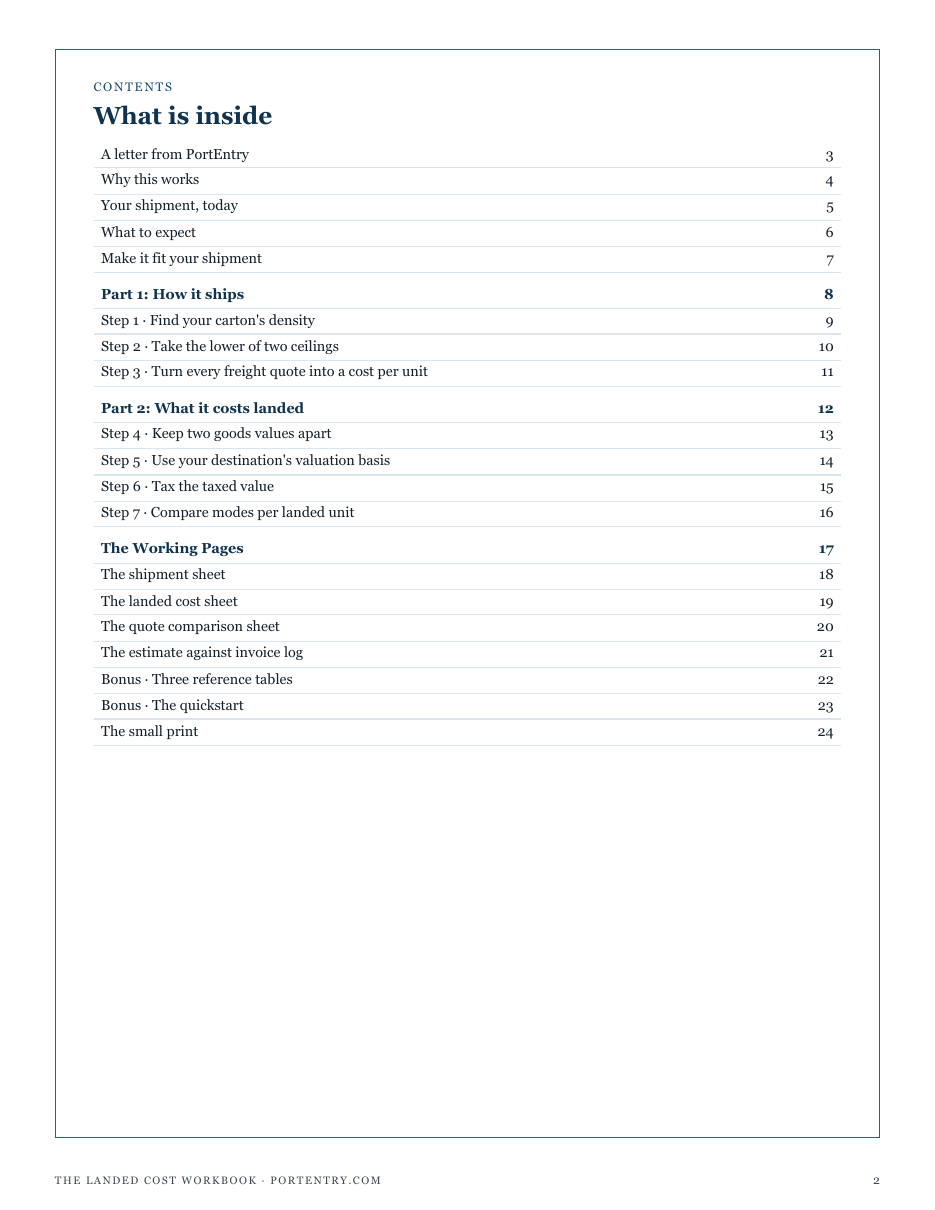
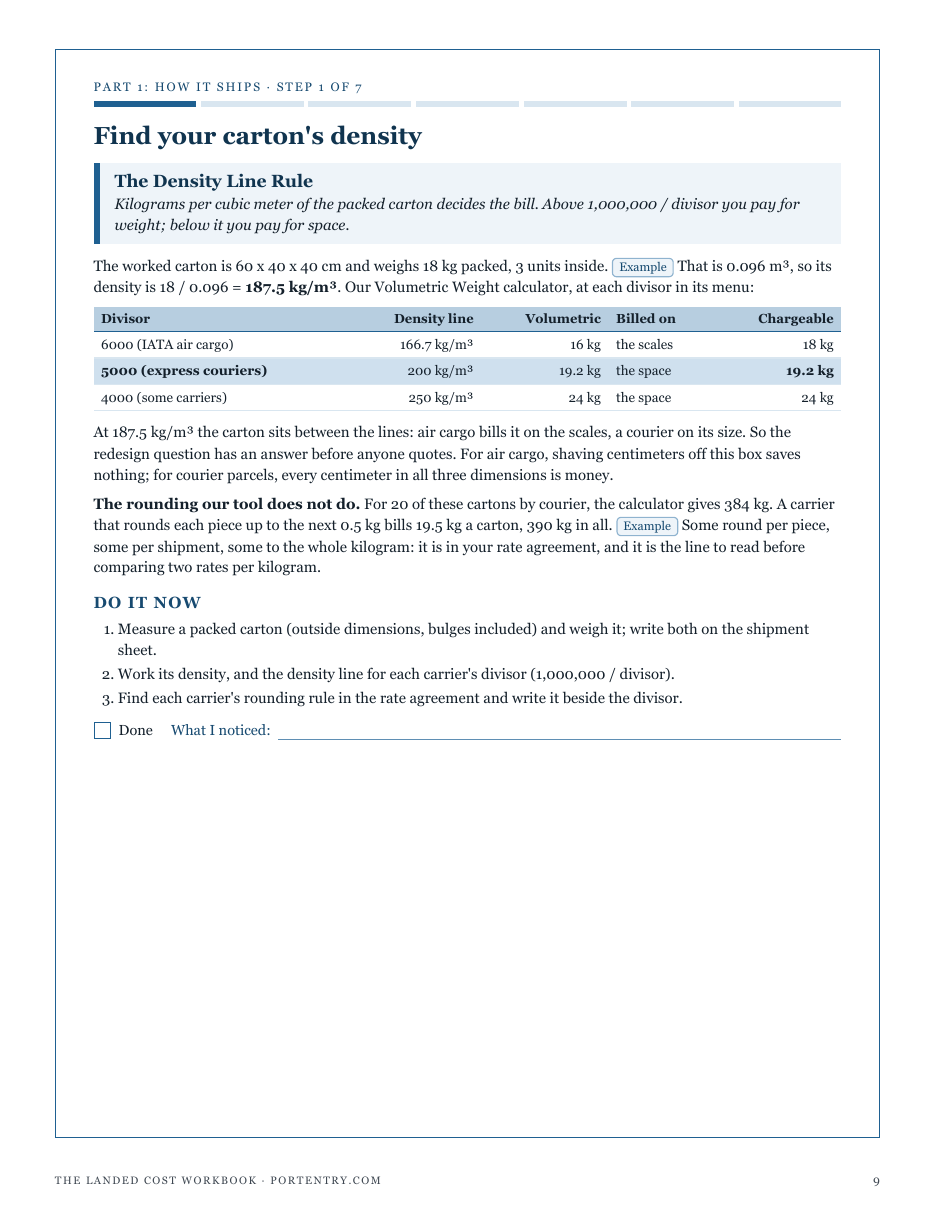
Two full pages from the workbook, exactly as printed. Click either to read it at full size before you decide.
What is in it
- The Density Line Rule: your carton's kg per cubic meter against each divisor, and the carrier's rounding
- The Two Ceilings Rule: containers counted by the lower of space and payload
- The Per-Unit Freight Rule: air, LCL and container quotes turned into freight per unit, with LCL break-evens
- The Two Values Rule: goods as paid and goods as customs converts them, kept apart
- The Destination Basis Rule: FOB-type and CIF-type customs values, and the itemized invoice
- The Taxed-Value Rule: duty, then import tax on value plus duty plus fees, and whether it is a cost
- The Landed Unit Rule: landed cost per unit by mode and basis, beside your selling price
- Working pages: shipment sheet, landed cost sheet, quote comparison sheet, estimate against invoice log
- Reference tables: where payload binds by box, when a container beats LCL, common carton sizes
- Quickstart, and a personalised sheet worked from your calculator figures
- ✓ 24 printable pages
- ✓ 10 sections, worksheets and templates
- ✓ A second PDF worked out from the numbers you enter
- ✓ No account needed, just an email address
- ✓ Instant download; link valid 7 days
Price includes any taxes. Sold by GrabURL, who handle checkout and support. The charge appears on your statement as GrabURL.
The workbook picks up where the free Container Load Calculator leaves off. The calculator counts cartons by volume only, the Volumetric Weight Calculator gives a chargeable weight that never becomes a freight figure, and the Customs Value Calculatorlets you choose a valuation basis your destination has already chosen for you. The workbook counts containers by space and payload, turns every freight quote into a cost per unit, keeps the value you paid apart from the value customs uses, applies your destination’s basis, and ends in one landed cost per unit for each way the goods could travel. Every rate in it is an example for you to replace. It is not a customs assessment or tariff classification: confirm your HS code and duty rate with your customs authority or a licensed customs broker.